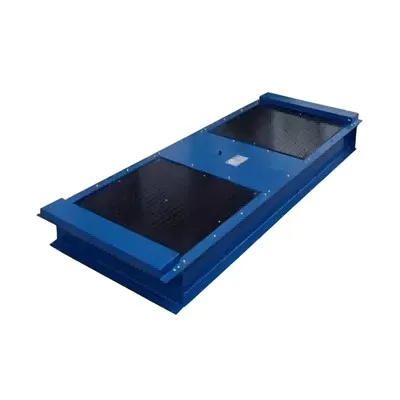
Non-destructive Testing Methods For Automobile Testing Equipment
Jan 16, 2024
Four-wheel positioning in vehicle detection equipment is to maintain the vehicle's performance and reduce the wear and tear of tires and steering parts in the car. Front wheel positioning includes kingpin back Angle and kingpin inner Angle.
Looking at the wheel from the side, the steering kingpin (the center of rotation when the wheel turns) is tipped backwards, called the kingpin rear Angle. After setting the rear inclination Angle of the kingpin, the distance between the ground point of the kingpin center line and the ground projection point of the wheel center is generated (called the kingpin pitch shift, the same principle as the bicycle's front wheel fork beam tilting backward), so that the wheel ground point is located at the back end of the steering kingpin extension line, and the wheel is pulled back by the rolling resistance in the running, so that the direction of the wheel is naturally toward the direction of travel. Setting a large kingpin rear Angle can improve the straight-line driving performance and increase the kingpin pitch shift. The kingpin pitch shift is too large, will make the steering wheel heavy, and due to road interference will aggravate the wheel bump.
When looking at the tire from the front and rear of the car, the kingpin shaft tilts to the inside of the body, which is called the kingpin inclination Angle. When the wheel rotates with the kingpin as the center, the low point of the wheel will fall below the road surface, but in fact the lower edge of the wheel can not fall below the road surface, but the steering wheel and the entire front of the car will be lifted up a corresponding height, so that the gravity of the car itself has the effect of restoring the steering wheel to the original middle position, so the steering wheel is easy to reset.
The main function of automobile speed sensor is to provide engine speed information and crankshaft top dead center information in distributor less ignition system. Use with pulse disk. The pulse disk is a tooth disk that originally had 60 teeth, but two teeth were missing. The pulse disk is mounted on the crankshaft and rotates with the crankshaft. When the tooth tip passes close to the end of the sensor, the pulse disk made of ferromagnetic material cuts the magnetic field line of the magnet in the sensor, and generates an induced voltage in the coil, which is output as a speed signal.
Vehicle testing equipment regularly tests the comprehensive performance of electric vehicles and operation and environmental protection, electric vehicles, let's understand what the main task of the vehicle testing equipment is.
1. Test and diagnose the technical status of transport vehicles in use.
2, automobile testing equipment for the maintenance of electric vehicle maintenance industry quality testing.
3, accept the commission, vehicle modification, transformation, scrapping and related new processes, new products, results and other projects to test, provide test results.
4. Entrusted by the departments of public security, commodity inspection, metrology and insurance, automobile testing equipment will test relevant items and provide test results.
Non-destructive testing method for automobile testing equipment
1. Radiographic inspection, using the attenuation characteristics of rays (X-rays, gamma rays and neutron rays) propagating in the medium, when the rays of uniform intensity are injected from one side of the tested part.
2, magnetic particle detection, due to the defect and the substrate material magnetic characteristics (magnetoresistance) is different through the matrix of the magnetic force line at the defect will be curved and may escape the matrix surface, forming a leakage magnetic field.
3. Eddy current testing: When the alternating magnetic field is close to the conductor (part under test), a closed ring current will be induced in the conductor due to electromagnetic induction, which is eddy current.
4, penetration detection, the use of capillary phenomenon and infiltrating effect of osmotic fluid on the inner wall of the defect, so that the osmotic fluid into the defect, the excess osmotic fluid out, the residual defect in the osmotic fluid can adsorb the developer to form contrast, size enlargement of the defect image.