

Shandong Zhengneng Auto Test Equipment : Your Professional Vehicle Sideslip Test Bench Manufacturer !
Our company has focused on automobile inspection technology research for more than 30 years. Our main products are new car high-end inspection lines (including non-contact dynamic four-wheel alignment, integrated drum platform, gantry headlight instrument, ADAS calibration, rain room drying room, safety Innovative products such as electrical testing and automotive R&D chassis dynamometers) driverless intelligent chassis performance testing system and vehicle external perception and automatic safety function effectiveness testing system, which can replace imported equipment.
Rich Product Range
The company's main products include high-end testing lines (including non-contact four-wheel alignment, comprehensive roller test bench, dual-axis ABS brake tester, gantry headlight tester, etc.), driverless testing lines, offline testing equipment automobile factory ( Four-wheel alignment, brake tester, speed tester, sideslip tester, axle load tester, etc.
Advanced Production Equipment
In order to ensure production, we have different processing equipment, such as lathes, drilling, milling and boring grinders, milling and drilling machines, balancing machines, metal band saws, air compressors, flame cutting machines, metal band saws, plasma cutting machines, radial drills, etc.
Widely Sold
Our equipment is exported to overseas automobile manufacturers such as Russia, Iran, Nigeria, Thailand, Uganda, South Korea, and Myanmar. And our cooperative customers include well-known domestic automobile manufacturers such as Geely, Changan, and GAC.
Quality Guaranteed
The products produced by our company have passed quality inspection, and our team has 3 authorized invention patents, 38 utility model patents, and 22 soft patents.
-

The sideslip is a kind of equipment used to detect the positioning of the front wheel of the vehicle, mainly used to detect whether there is lateral slip during the running of the vehicle. By
Add to Inquiry -
The skateboard type vehicle sideslip test bench is used to measure the matching of wheel camber and front bundle in the process of straight line driving, which is symbolized by the amount of sideslip.
Add to Inquiry -
The skateboard type vehicle sideslip test bench is used to measure the matching of wheel camber and front bundle in the process of straight line driving, which is symbolized by the amount of sideslip.
Add to Inquiry -
Detect the sideslip of the front wheel when the vehicle is driving, or detect the sideslip of the vehicle after the four-wheel positioning adjustment;. Equipment functions: with wheel relaxation
Add to Inquiry


What is Vehicle Sideslip Test Bench
A Vehicle Sideslip Test Bench, also known as a sideslip testing system or simply a sideslip tester, is a specialized equipment used in automotive testing facilities and vehicle development labs to evaluate the handling characteristics of automobiles. This test bench is particularly designed to assess the vehicle's behavior when it experiences sideslip, which occurs when the vehicle's direction of travel deviates from its longitudinal axis.
Features of Double Plate Side Slip Tester
Dual Plate Configuration
The Double Plate Side Slip Tester consists of two separate plates or rollers onto which the vehicle's wheels are driven. This dual plate configuration allows for independent control of lateral forces applied to each wheel, enabling more precise simulation of sideslip conditions and vehicle dynamics.
Hydraulic Actuation
The tester typically employs hydraulic actuators or pneumatic systems to apply lateral forces to the vehicle's wheels. These actuators can exert controlled forces to induce sideslip and simulate various driving maneuvers such as cornering, lane changes, and evasive maneuvers.
Adjustable Force and Speed
The Double Plate Side Slip Tester offers adjustable parameters for the magnitude and rate of lateral force applied to the vehicle's wheels. This allows operators to tailor the testing conditions to simulate different driving scenarios and evaluate the vehicle's response across a range of speeds and maneuvering intensities.
High-Resolution Sensors
Precision sensors are integrated into the tester to measure key parameters such as wheel slip, lateral acceleration, yaw rate, steering angle, and tire forces. These sensors provide accurate real-time data on the vehicle's dynamic behavior during sideslip events, enabling comprehensive analysis and evaluation.
Parts of Double Plate Side Slip Tester


Rollers or Plates
The primary components of the tester are two parallel rollers or plates onto which the vehicle's wheels are driven. These rollers/plates are typically made of durable materials such as steel and are precisely machined to provide a smooth and level surface for the wheels.
Hydraulic Actuators
Hydraulic actuators are used to apply lateral forces to the rollers/plates, inducing sideslip conditions in the vehicle. These actuators are controlled by the testing system and can exert precise amounts of force to simulate various driving maneuvers.
Sensor Array
The tester is equipped with a sophisticated sensor array to measure key parameters related to the vehicle's dynamic behavior during testing. This sensor array typically includes sensors for wheel slip, lateral acceleration, yaw rate, steering angle, and tire forces.
Data Acquisition System
A data acquisition system is integrated into the tester to collect, record, and analyze the data from the sensor array. This system captures real-time measurements of the vehicle's performance during testing, allowing engineers and researchers to assess its handling characteristics.
Control Unit
The control unit serves as the brain of the Double Plate Side Slip Tester, managing the operation of the hydraulic actuators, sensor array, and data acquisition system. It allows operators to configure test parameters, monitor test progress, and control the testing process.
User Interface
The tester features a user-friendly interface that allows operators to interact with the control unit and monitor the testing process. This interface may include touchscreen controls, graphical displays, and intuitive software for ease of operation.
Safety Features
Safety is a critical consideration in automotive testing environments, and Double Plate Side Slip Testers are equipped with various safety features to protect personnel and equipment. These may include emergency stop buttons, safety interlocks, overload protection, and safety barriers.
Frame and Structure
The tester is supported by a robust frame and structure that provides stability and rigidity during testing. This frame is typically constructed from welded steel or aluminum and is designed to withstand the forces exerted by the vehicle and hydraulic actuators.
Power Supply
The tester requires a power supply to operate its hydraulic actuators, control unit, and other electrical components. This power supply may be provided by mains electricity or an onboard generator, depending on the testing environment.
Working Principle of Double Plate Side Slip Tester
Preparation
The vehicle is driven onto the Double Plate Side Slip Tester platform and properly positioned for testing. The wheels of the vehicle are aligned with the parallel rollers or plates of the tester.
Initialization
The testing parameters are set up using the control unit interface. This includes configuring the desired lateral force to be applied to each wheel, defining the speed at which the test will be conducted, and selecting any specific test scenarios or maneuvers to simulate.
Hydraulic Actuation
Hydraulic actuators integrated into the tester apply lateral forces to the rollers or plates, inducing sideslip conditions in the vehicle. These lateral forces simulate real-world driving scenarios such as cornering, lane changes, or evasive maneuvers.
Data Acquisition
During the test, a sensor array installed on the tester platform and the vehicle captures real-time data related to the vehicle's dynamic behavior. This includes measurements such as wheel slip, lateral acceleration, yaw rate, steering angle, and tire forces.
Data Analysis
The collected data is processed and analyzed using the tester's data acquisition system and control software. Engineers and researchers can analyze the vehicle's handling characteristics, stability, and responsiveness during sideslip events based on the recorded measurements.
Performance Evaluation
The test results are evaluated to assess the vehicle's performance under different sideslip conditions. This includes examining factors such as its ability to maintain control, stability, and directional stability during cornering or maneuvering.
Adjustment and Optimization
Based on the test results, adjustments may be made to the vehicle's suspension settings, tire characteristics, or electronic stability control systems to optimize its handling performance and stability under sideslip conditions.
Safety Precautions
Throughout the testing process, safety precautions are observed to ensure the safety of personnel and equipment. This may include emergency stop mechanisms, safety interlocks, and protective barriers to prevent accidents or injuries during testing.
How to Choose Double Plate Side Slip Tester
Testing Requirements
Identify your specific testing needs and requirements. Consider the types of vehicles you will be testing (e.g., passenger cars, trucks, buses), as well as the range of testing scenarios you need to simulate (e.g., cornering, lane changes, evasive maneuvers).
Capacity and Compatibility
Ensure that the Double Plate Side Slip Tester you choose has the capacity and compatibility to accommodate the vehicles you intend to test. This includes factors such as weight capacity, wheelbase range, and tire size compatibility.
Accuracy and Precision
Look for a tester that offers high accuracy and precision in its measurement capabilities. This includes accurate measurement of parameters such as wheel slip, lateral acceleration, yaw rate, steering angle, and tire forces.
Hydraulic System
Evaluate the hydraulic system of the tester, including the type of actuators used and their capabilities. Hydraulic actuators should be able to apply controlled lateral forces to induce sideslip conditions accurately.
Sensor Array
Consider the sensor array integrated into the tester for data acquisition. Look for a tester that offers a comprehensive sensor array capable of capturing real-time data on the vehicle's dynamic behavior during testing.
Data Acquisition and Analysis Software
Assess the data acquisition and analysis software provided with the tester. It should offer user-friendly interfaces for configuring tests, monitoring test progress, and analyzing test results effectively.
Safety Features
Prioritize safety features in the Double Plate Side Slip Tester to ensure the safety of personnel and equipment during testing. This includes emergency stop mechanisms, safety interlocks, and protective barriers.
Ease of Use and Maintenance
Choose a tester that is easy to operate and maintain, with intuitive controls and minimal downtime for maintenance and calibration.
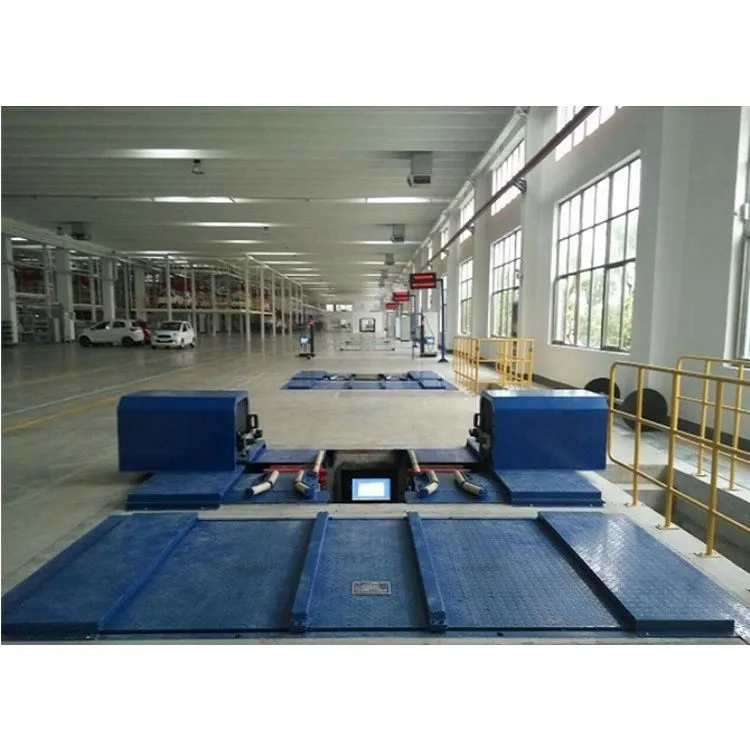
A Veneer Side Slip Tester is a device used in the automotive industry to measure the side slip angle of a vehicle's tires. Side slip angle refers to the angle between the direction in which a vehicle is traveling and the direction in which its tires are pointing. It's an important parameter in vehicle dynamics as it affects the vehicle's stability, handling, and cornering performance. The Veneer Side Slip Tester typically consists of sensors placed on the vehicle's wheels or tires that detect the actual direction in which the wheels are pointing, and compare it to the direction of motion. By analyzing this data, the device can calculate the side slip angle.
Features of Veneer Side Slip Tester
Adjustable Load
Veneer Side Slip Tester allows the application of controlled weight or force to simulate various walking conditions from light to heavy loads.
Tilt Mechanism
The sideslip tester has an adjustable tilt function that can change the angle of the test surface, allowing testing at different tilts to evaluate the performance of materials under different conditions.
Data Output
Advanced models may have digital readouts or connections to computers for recording and analyzing data, which can be particularly useful for large-scale quality control operations.
Security Function
Safety features such as emergency stop buttons, protective covers and clear operating instructions are important to ensure operator safety during testing.
Certificate


Frequently Asked Questions
We're well-known as one of the leading vehicle sideslip test bench manufacturers and suppliers in China. Please feel free to buy customized vehicle sideslip test bench at competitive price from our factory. Good service and quality products are available.
Veneer Side Slip Tester, Vehicle Sideslip Test Bench, Auto Side Slip Tester